

Edit Source
When you select Edit Source from the Source-IV Main Menu, the system displays the following:
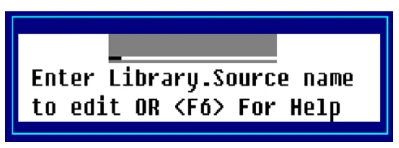
You can edit an existing Source module or create a new Source library and/or a new Source module. Enter the name of the Source that you wish to edit. The format of the entered name is as follows:
LIBRARY NAME (1-4 chars) . SOURCE NAME (1-8 chars)
Example: MYLB.PROG1
From the Library.Source window above you can press F2 for a lookup of existing library names. The system displays the Library File View:
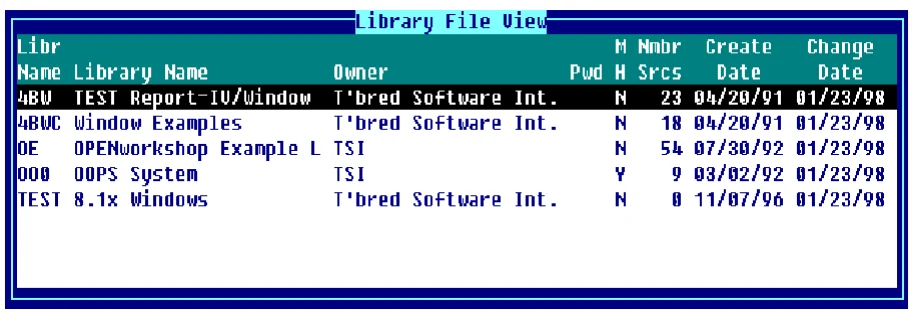
From the Library File View, you can highlight the library you wish to select and press Enter to select it. The name of the library you selected is displayed in the Library.Source name window. If you enter a library name that does not exist the system displays the Create New Library Screen:

Libr Name Type a library name (1-4 characters) any combination of letters, numbers or characters (except spaces ? / \ * [ } @).
Press F2 to view a list of libraries. The list contains all of the currently defined libraries. You may wish to use the Up Arrow and Down Arrow keys to scroll to the desired library name and press Enter to select that library.
Library Description Type from 1 to 30 alphanumeric characters to describe the library being created. This is an optional field and may be left blank.
Owner Type from 1 to 25 alphanumeric characters to define the owner of the library. This is an optional field and may be left blank.
Pwd Type from 1 to 3 alphanumeric characters for the library password. library Passwords are used to control access to Source documents. Passwords may also be specified for each Source document. This is an optional field and may be left blank. Two reserved passwords are available to specify how the resultant executable object is to be compiled; non-protected (listable) or protected (non-listable).
- NOL
- does not restrict Source access, but causes executable object to be compiled protected.
- LON
- does not restrict Source access, but causes executable object to be compiled non-protected.
MH Maintain Edit History gives the user the ability to undo changes made to a Source, and to also produce an Undo Change Notice that shows exactly what changes were made to a particular Source. Type Y or N in this field. For more information, see the section on Source Locking and Edit History in this document.
This indicates whether or not Source-IV should maintain the Edit Session History for all Source in this library.
- Y
- Edit sessions will be maintained for all Source in this library. You will be required to Lock/Unlock Source in order to make changes.
- N
- Edit sessions will not be maintained for all Source in this library. If this was previously set to Y and edit history exists when a Source is edited, you will be prompted to remove the edit history for that Source.
- There
- are two types of records that are maintained by Source-IV when maintaining edit history:
- Lock Intervals Records that are created every time a Source is locked. This record is used to separate each change to a Source.
- Edit Session Records that contain the changes made each time the locked Source is saved from the editor. There can be an unlimited number of edit sessions for each lock interval. For more information, see Source Locking/Edit History.
Nmbr Srce
This field displays the number of Source documents in the specified library.
Create Date
This field displays the date the library was created.
Lst Chng Date
This field displays the date of the last change made to the specified library.
Once a library is selected you can press F2 and the system displays the Source File View:
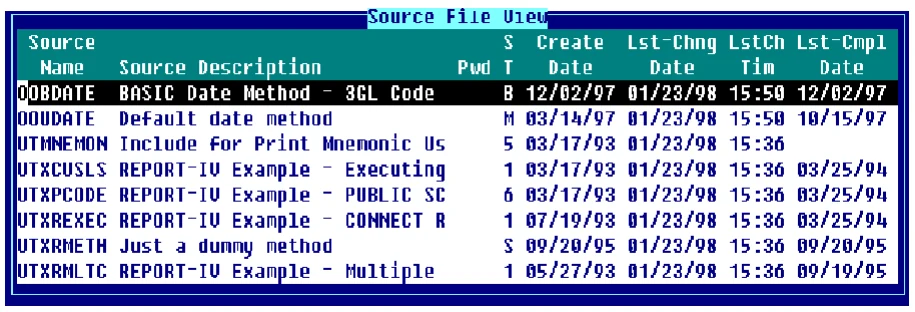
From the Source File View you can edit a Source file by highlighting the Source file name and pressing Enter.If you enter a new Source name the system displays the Create New Source Screen:

Source Name The Source name entered when creating a new Source can be from 1 to 8 characters any combination of letters, numbers or characters (except spaces ? / \ * [ ] @). The system will display the Create New Source Screen as shown above.
Source Description Type from 1 to 40 alphanumeric characters to describe the Source being created. This is an optional field and may be left blank.
Pwd Type from 1 to 3 alphanumeric characters for the Source password. Source passwords are used to control access to a Source document. Passwords may also be specified for each Source document. This is an optional field and may be left blank. Two reserved passwords are available to specify how the resultant executable object is to be compiled; non-protected (listable) or protected (non-listable).
- NOL
- does not restrict Source access, but causes executable object to be compiled protected.
- LON
- does not restrict Source access, but causes executable object to be compiled non-protected.
ST
This field allows you to specify the type of Source being created.
1-Primary (Script-IV)
Used as a starting point for processing.
2-Continuation (Script-IV)
Continuation of a primary or another continuation script.
**3-**Overlay (Script-IV)
Overlay to a primary, continuation, or another overlay script. It is a specialized type of continuation script that conserves memory and functions differently from a continuation script.
**4-**Pre/Post (Script-IV)
Used for pre/post processing in Dictionary-IV File Maintenance.
5-Copy (Script-IV/Basic)
When used in conjunction with the INCLUDE command, this Source can serve to save time and avoid duplication when writing scripts or Thoroughbred Basic programs.
6-Public (Script-IV)
Independent routing to a primary, continuation, overlay, or another public script. Having an independent data environment, the public script does not belong to a script set or have a parent script.
B-BASIC (Basic)
A Thoroughbred Basic program.
M-Basic Method (OPENworkshop only)
A 3GL program.
P-PPS Pre/Post
Used for pre/post processing in Public Programming Services (8INPUT).
S-Script-IV Method (OPENworkshop only)
An OPENworkshop Script-IV Method.
U-Utility (Script-IV)
Same as a primary script, except that on startup:
The screen is not cleared.
The 3GL data environment is not initialized.
Open files are not closed; if run from a script be sure to close all open links before executing
(CLOSE ALL).
Create Date
This field displays the date the specified Source was created.
Lst-Chg Date
This field displays the date the last change was made to the specified Source.
LstCh Tim
This field displays the time the last change was made to the specified Source.
Lst-Cmpl Date
This field displays the date the specified Source was last compiled.
Once a Library.Source name is entered and you press Enter from the input field the Source Editor is invoked. If you entered an existing Source module, the Source is displayed. If you are creating a new Source module, you will have either a blank editor screen or a Source template. Templates are available for scripts and methods but not basic Source. For more information, see the Source Editor Features section.
From the Source-IV, version 8.9.1. Open this page in the PDF