

Object Technology Concepts
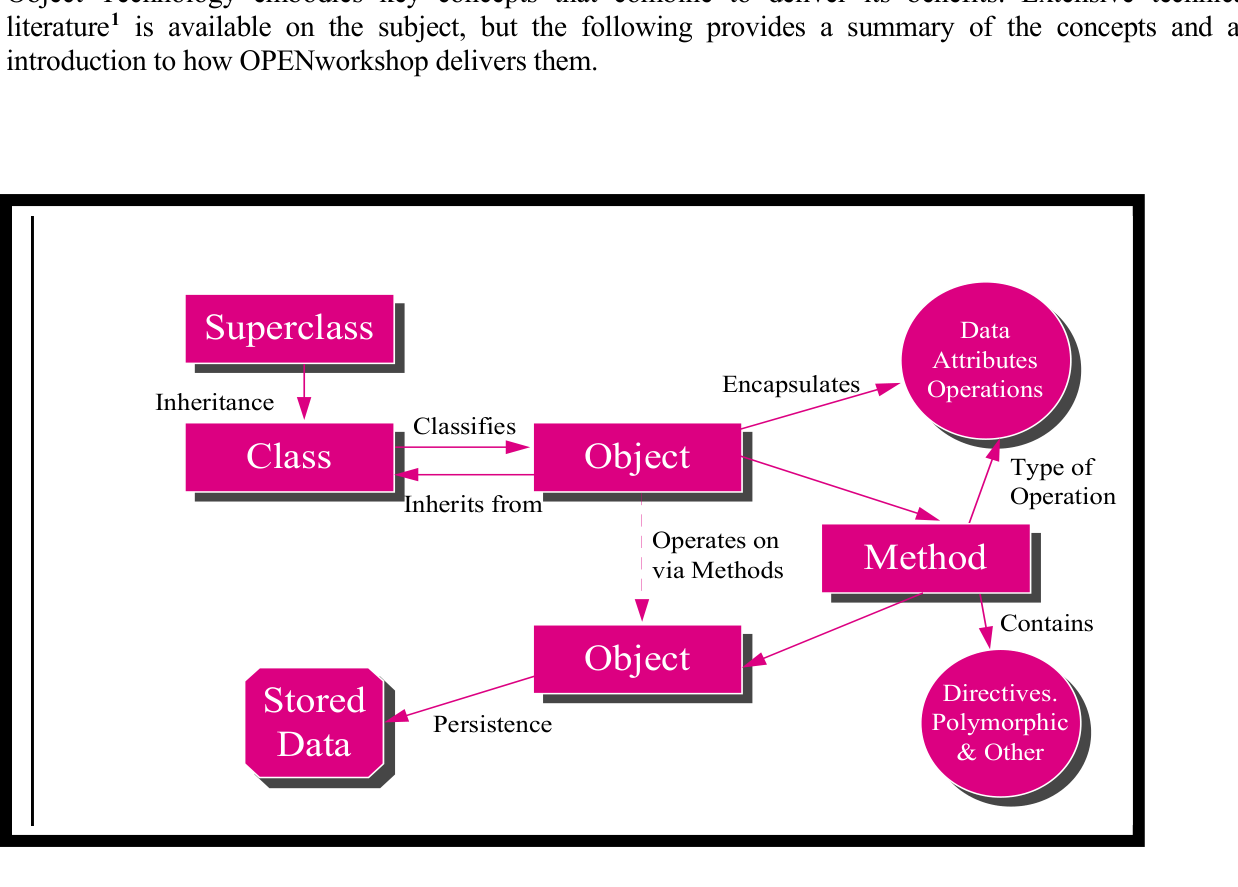
Object Technology embodies key concepts that combine to deliver its benefits. Extensive technical
Object
Section titled “Object”Is any thing, real or abstract, about which we store data and those operations that manipulate the data.
(James Martin)
OPENworkshop allows the developer to store information that reflects the properties of real world items in Data-names. The operations that may manipulate the data are defined in Methods and are associated with the Data-name.
A collection of objects, which share common attributes and methods.
(Ian Graham)
See bibliography for a small sample
1 In OPENworkshop Classes define a collection of Objects. Classes themselves are collected into sets with common structures or behavior. For example, all Views in OPENworkshop have similar behavior.
Method
Section titled “Method”An implementation of an operation. Code that may be executed to perform a requested service. Methods associated with an Object may be structured into one or more programs.
(Object Management Group)
OPENworkshop Methods perform operations on Data-names. Some specific types of operation are identified for particular support by OPENworkshop, including:
- Pre- and Post-Processing Methods prepare an Object for modification by the end-user and validate the data afterwards.
- Insert Methods assist in creating a new Object.
- I/O triggers validate the database and ensure that updates are performed consistently.
Inheritance
Section titled “Inheritance”The construction of a definition by incremental modification of other definitions.
(Object Management Group)
In OPENworkshop all Classes are created and modified incrementally, and any definition created is interpreted consistently wherever it is referenced. OPENworkshop Formats and Links are used to collect these definitions together.
Encapsulation
Section titled “Encapsulation”Are the results (or act) of hiding the implementation details of an Object from its user?
(James Martin)
An Object may CONNECT to another OPENworkshop Object, and allow it to perform the operations it needs. When it has finished, it may return a value.
It is the combination of these concepts that allows developers to reduce application development and maintenance costs.
Polymorphism
Section titled “Polymorphism”The ability to use the same expression to denote different operations.
(Ian Graham)
An expression or message can operate on Objects of different Classes. This type of re-useable code greatly reduces development and maintenance costs.
Recursive
Section titled “Recursive”Objects can send messages to their own Methods recursively or send messages to themselves.
(Ian Graham)
The ability to interrupt an action to undertake another action or subroutine, and then to interrupt this again with the same subroutine and so on. For the Thoroughbred Environment this is equivalent to Public Programs.
Persistence
Section titled “Persistence”The property of an object by which its existence transcends time.
(Object Management Group)
The value of data remains after the Class or Method that created it no longer exists. An example is Data Objects that can be stored in files, which is the ultimate form of persistence.
From the OPENworkshop Reference, version 8.9.1. Open this page in the PDF