

OPENworkshop System Concepts
Traditional software architectures are hierarchical in design, driven by a number of programs. Typically, users can select a program from a set of choices on a menu. Programs engage in a dialog with the user through data input screens, and may display data in lists and tables. The application program controls both the dialog with the user and the maintenance and updating of data items.
OPENworkshop redefines the relationships between data and program code, and between application designer and application user. Developers using OPENworkshop must design their Data Objects first, and then associate “Methods”, which are independent modules of program code, with data items.
Because individual data elements control their own code, OPENworkshop eliminates any concept of a MAIN program. In place of a control structure that is imposed on the user through menus and escape keys, (all of which must be designed and planned for by the developer), OPENworkshop provides CONNECT directives, pop-up menus and user interface support that allows the user to control the dialogue with the system.
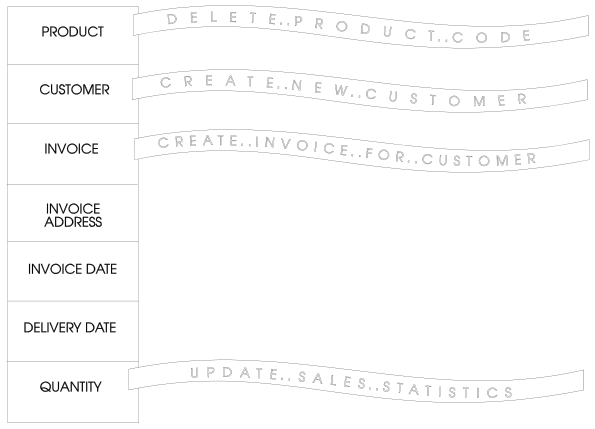
In OPENworkshop the data controls the application code, not the other way around. The system architecture enables the developer to partition the application code into Methods associated with Objects.
Because Objects are then packaged with their Methods, they are easy to re-use. Previous work is immediately available to use when creating other Objects with similar properties. Future modifications are automatically reflected in all places where the Object is used.
These benefits are important during initial application design, but even more important during the much longer maintenance life of an application.
From the OPENworkshop Reference, version 8.9.1. Open this page in the PDF