

Dynamic Data Exchange (DDE)
Microsoft provides the Dynamic Data Exchange (DDE) mechanism to support communications between any two applications running in the Windows environments. Thoroughbred Gateway for Windows extends that communication channel beyond the limits of the Windows workstation to the host environment. This allows the host application developer to communicate directly with Windows-based software using existing DDE interfaces.
To communicate with a DDE application, you need only construct a DDE instruction or multiple instructions. Communication can be two-way; you can send and receive information.
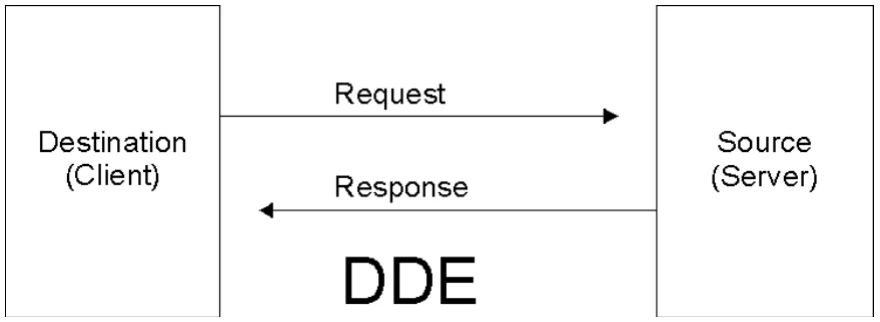
The Destination (Client) sends a Request to the Source (Server).
The Source (Server) sends a Response to the Destination (Client).
DDE follows the Client/Server model for communications control, but uses the terms: destination and source. The destination initiates a conversation, while the source responds to the request.
There are three basic types of DDE connection: hot, warm, and cold links.
- Hot and warm links force the source to notify the destination anytime changes in data values occur after the data has initially been transmitted to the Destination.
- Cold links require that the Destination requests an update when it is ready. Gateway for Windows supports cold DDE links, since it is integrating a host interrupt-driven environment with workstation event-driven applications.
Host to PC Communication
Section titled “Host to PC Communication”Gateway for Windows extends the DDE communication channel beyond the boundaries of a Windows workstation, to application software running within an operating system environment. The host and Windows workstation can be connected via network communication paths. The Thoroughbred Terminal emulator (TbredComm) is required if you connect to the host using a telnet connection.
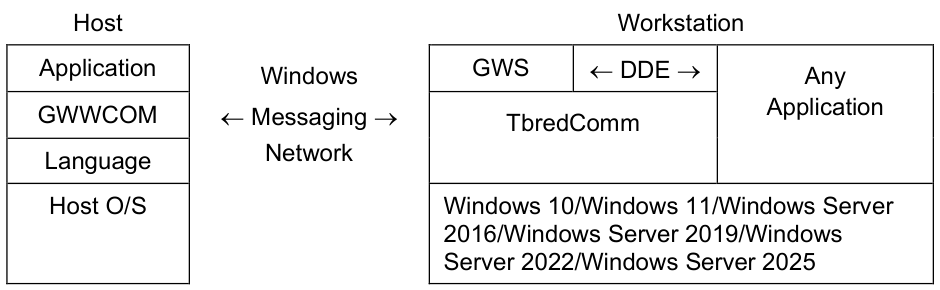
Gateway for Windows uses GWWCOM, a Thoroughbred Dictionary-IV API running in the host environment. It controls all communications with the PC workstation. In the host, 3GL or 4GL programs may be written containing CALLs to GWWCOM.
The Gateway Communications and VIP Gateway for Windows modules in the workstation accept all DDE communications from the host and distribute them within the workstation as required. These modules also control requests from workstation applications for communication with an application in the host.
Multiple DDE Channels
Section titled “Multiple DDE Channels”Gateway for Windows can process an unlimited number of DDE conversations at the same time. The conversations can involve any number of applications (memory permitting). With Gateway for Windows you may also have multiple conversations with the same application.
Non-DDE Applications
Section titled “Non-DDE Applications”If a workstation application does not support a DDE interface, the host application is still able to command the PC application, using keyboard focus. In this case the host operates the application as a keyboard operator. No response can be received from the application.
Windows 10/Windows 11/Windows Server 2016/Windows Server 2019/Windows Server 2022/Windows Server 2025 Environments
Section titled “Windows 10/Windows 11/Windows Server 2016/Windows Server 2019/Windows Server 2022/Windows Server 2025 Environments”Applications written in Thoroughbred development languages that have been designed to operate with VIP Gateway for Windows from standard host environments (UNIX, Linux, SCO, etc.) can also operate without modification from the Thoroughbred host Windows environments (Windows 10/Windows 11/Windows Server 2016/Windows Server 2019/Windows Server 2022/Windows Server 2025). VIP Gateway for Windows provides the VIPWIN module to replace the Gateway Communications module. It is entirely transparent to the application software.
From the Gateway for Windows Reference, version 8.9.1. Open this page in the PDF