

Product Description
TS DataServer for MS SQL Server Components
Section titled “TS DataServer for MS SQL Server Components”The TS DataServer for MS SQL Server consists of three components:
- A Client enabled TS Environment,
- A Manager Process that runs as a Windows Service (tsmssqlmgr), and
- A Server Process (tsmssql) for each connection.
Client Enabled TS Environment
Section titled “Client Enabled TS Environment”The client side is enabled in the standard TS Environment. When configured for data server access, it detects requests for data that reside on the server. When this event occurs, it sends the I/O request to the server for processing. The server responds with the result set and processing continues.
Manager Process
Section titled “Manager Process”The Manager program runs as a Windows Service. The Manager Program (tsmssqlmgr) creates Server Processes for clients as needed. When the Service detects a client attempting to connect, it tries to create a Server Process for the client. If a Server Process is created successfully, the client and server can perform client/server communications.

Server Process
Section titled “Server Process”The Server Process (tsmssql) is triggered by requests from the client. Once a request is received, it is processed and the results returned to the client.
System Architecture
Section titled “System Architecture”The following diagrams outline the core options for configuring the components of the Thoroughbred client.
- Client and server on one system
- Client on one system - server on another
Client and Server Co-exist on One System
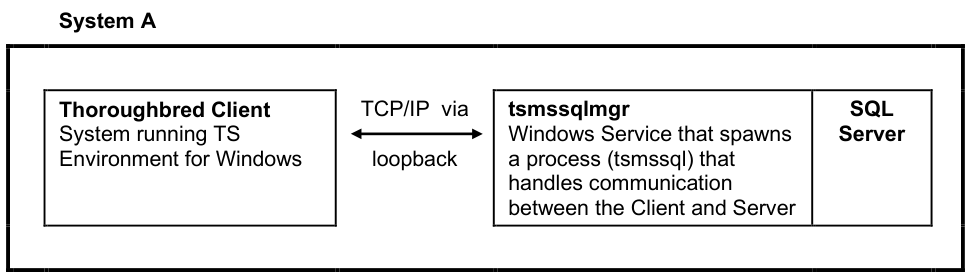
In the layout described by the above figure, the information is sent to the Server Process through the loopback TCP/IP address.
Client on System A and Server on System B
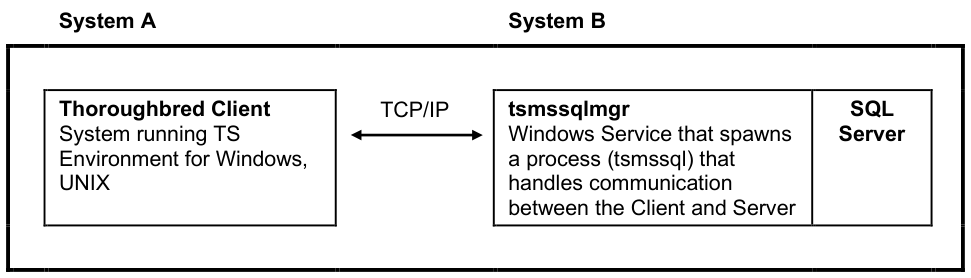
In the above figure the information is sent over the network to the server system. Once the requests reach the Server Process it creates SQL statements that are interpreted by the server system. The results are then passed back to the client through the Server Process.
From the TS DataServer for MS SQL Server, version 8.9.1. Open this page in the PDF